Weather systems in Minecraft Bedrock typically cycle through clear, rainy, and thunderstorm conditions with minimal impact on gameplay beyond mob spawning and crop growth. The vanilla experience offers little variation or challenge when it comes to environmental conditions. Weather and climate addons transform this static system into a dynamic, sometimes dangerous element that affects how you build, explore, and survive.
Advanced weather mods introduce tornadoes that destroy terrain, blizzards that reduce visibility and movement speed, hurricanes that flood coastal areas, and seasonal changes that alter biome appearance throughout the year. These addons create new survival challenges and opportunities. You might need to build storm shelters, prepare winter supplies, or time your farming around realistic growing seasons. Some mods focus on visual spectacle with enhanced rain particles and lightning effects, while others emphasize gameplay mechanics like temperature management and weather-based hazards.
The right weather addon depends on your gameplay preferences. Survival players benefit from mods that add temperature systems and environmental threats. Builders appreciate seasonal changes that provide fresh aesthetics for screenshots and videos. Adventure map creators can use extreme weather events to create dramatic scenarios and timed challenges.
Realistic Simulation Addons
Explore addons that bring real-world physics, mechanics, and environmental systems to your Bedrock worlds.
Browse Collection →Understanding Weather System Types
Weather addons for Minecraft Bedrock Edition fall into several distinct categories based on their core mechanics and focus areas. Recognizing these differences helps you select mods that match your gameplay style and performance requirements.
Environmental hazard mods prioritize dangerous weather events. Tornadoes spawn randomly in plains biomes, carving destructive paths through your builds. Hurricanes generate over ocean areas and push toward coastlines. Blizzards appear in cold biomes, reducing visibility to a few blocks and applying slowness effects. These addons typically include warning systems like darkening skies or specific sound cues before major events occur.
Seasonal cycle addons modify biome appearance based on calendar progression. Spring brings flowering trees and increased animal spawning. Summer intensifies colors and accelerates crop growth. Autumn turns leaves orange and red while slowing food production. Winter covers temperate biomes with snow layers and freezes water sources. Most seasonal mods divide the Minecraft year into four equal periods, with each lasting approximately 20 in-game days.
Temperature and climate mods add survival mechanics based on environmental conditions. Your character gains temperature meters that decrease in cold biomes or during rain exposure. Hypothermia effects include hunger depletion, slowness, and eventually damage. Heat exhaustion occurs in deserts and near lava sources. Players must craft appropriate clothing, build fires, or seek shelter to maintain safe body temperature.
Visual enhancement addons focus on graphical improvements without major gameplay changes. These mods add particle effects to rain and snow, create more realistic cloud formations, improve lightning strikes with branching patterns, and add atmospheric fog in certain conditions. Performance impact varies significantly based on particle density and rendering complexity.
Top Weather Event Addons
Natural Disasters Plus brings the most comprehensive extreme weather system to Bedrock Edition. This addon introduces six major disaster types: tornadoes, hurricanes, earthquakes, tsunamis, volcanoes, and meteor strikes. Each event has distinct warning signs and progression stages.
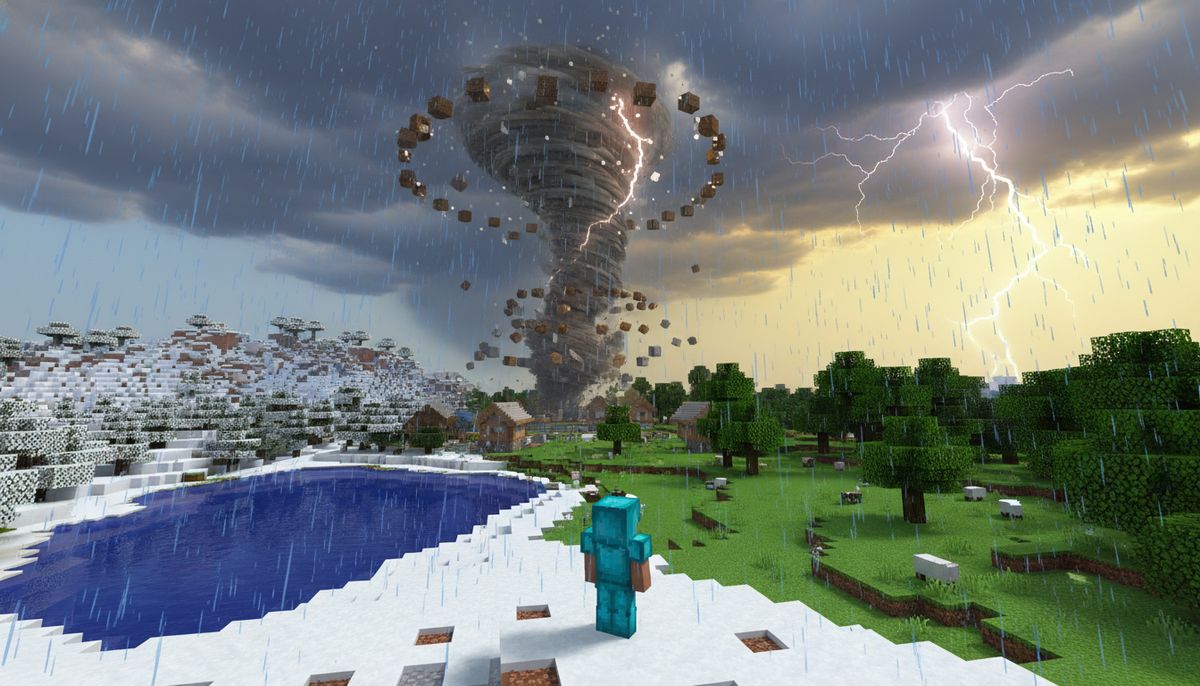
Tornadoes form in plains and savanna biomes when thunderstorms intensify. You'll notice funnel clouds descending from dark storm clouds approximately two minutes before the tornado fully forms. The vortex pulls loose blocks, animals, and players within a 30-block radius, flinging them into the air. Tornadoes move across terrain following semi-random paths, lasting between five and fifteen minutes before dissipating. The addon includes different tornado strengths rated EF0 through EF5, with stronger tornadoes destroying reinforced materials like stone and obsidian.
Hurricanes generate over deep ocean biomes and travel toward nearby landmasses. The addon displays a hurricane tracking interface showing projected paths and landfall locations. Storm surge mechanics raise water levels by 5-10 blocks along coastlines, flooding low-lying areas. Wind effects push players and mobs in the hurricane's rotational direction, making navigation extremely difficult. Rain intensity increases to near-zero visibility levels during the eye wall passage.
The earthquake system creates ground trembling effects that damage structures based on material durability. Stone and brick buildings suffer cracks that weaken structural integrity. Wood structures shake violently but typically survive with minor damage. The addon adds fault line generation to world creation, making certain regions more prone to seismic activity. Aftershocks occur randomly for several in-game days following major quakes.
Realistic Seasons Addon focuses exclusively on seasonal progression without extreme weather events. This mod divides the year into four 28-day seasons with smooth transitions between periods. Each season modifies biome appearances, mob behavior, and farming mechanics.
During spring, flowers spawn more frequently across grasslands and forests. Baby animals spawn at double the normal rate. Rain occurs more often, accelerating crop growth by 25%. Bees remain active throughout day and night cycles. Cherry blossom effects apply to oak and birch trees in certain biomes.
Summer intensifies all colors in temperate biomes. Grass blocks become more vibrant green. Crops grow at normal rates. Heat wave events occasionally occur in desert biomes, where players without cooling items receive slowness effects. Water sources in hot biomes evaporate one layer every three days unless replenished by rain.
Autumn introduces falling leaf particles that drift from trees. Oak and birch leaves gradually change to orange, red, and brown hues over the first two weeks of the season. Crop growth slows by 30%. Pumpkins and mushrooms spawn more frequently. Animal breeding cooldowns increase by 50%, simulating natural reproductive cycles.
Winter transforms temperate biomes with snow coverage. The addon adds a snow accumulation system where layers build up during snowfall events, eventually reaching full block height if left undisturbed. Lakes and rivers freeze over, creating ice surfaces thick enough to walk on. Crops stop growing entirely unless planted in greenhouses with nearby light sources. Cold weather animals like polar bears occasionally spawn in snowy forests.
Survival Challenge Addons
Test your skills with addons that increase difficulty through environmental hazards, limited resources, and survival mechanics.
Browse Collection →Temperature and Climate Mechanics
Weather 2000 introduces comprehensive temperature mechanics that affect player survival and world interaction. The addon adds a temperature gauge displayed above your hotbar showing current body temperature on a scale from -20°C to 50°C. The comfortable range sits between 15°C and 25°C. Deviations from this range trigger progressive status effects.
Environmental temperature calculations consider multiple factors. Biome type provides the base temperature value. Time of day modifies ambient temperature, with nights being 10°C cooler than midday. Weather conditions apply significant modifiers: rain reduces temperature by 5°C, snow by 10°C. Altitude adjustments decrease temperature by 2°C per 50 blocks above sea level. Proximity to heat sources like lava, fire, or torches raises local temperature by 1°C per source within five blocks.
Hypothermia develops when body temperature drops below 5°C. Stage one hypothermia applies Hunger I, causing food depletion at double rate. Stage two adds Slowness I and increases food consumption further. Stage three hypothermia inflicts Mining Fatigue II and deals half a heart of damage every thirty seconds. Death from exposure occurs within five minutes at stage three without intervention.
Heat exhaustion triggers above 35°C body temperature. Initial symptoms include accelerated thirst depletion if using compatible survival addons. Stage two heat exhaustion causes Nausea I and blurred vision effects. Stage three deals periodic damage similar to hypothermia's final stage. Desert exploration during midday routinely pushes temperature into dangerous ranges without protective measures.
The addon includes crafting recipes for temperature management equipment. Fur clothing crafted from leather and rabbit hide provides +8°C insulation, essential for tundra and mountain exploration. Cooling vests made from ice and leather reduce effective temperature by 10°C, allowing safe desert travel. Portable heaters crafted from iron blocks and coal burn for ten minutes, creating a mobile heat source.
Climate zones override vanilla biome temperature in favor of realistic geographical placement. Deserts generate exclusively near equatorial regions. Snowy tundras spawn only in polar areas beyond certain latitudes. This system creates more logical world layouts where you'll travel through progressively colder or warmer biomes rather than encountering jarring transitions between tundra and jungle.
Enhanced Weather Visuals
Storm Front Addon prioritizes visual improvements over gameplay mechanics. This mod dramatically enhances how weather appears without adding new survival challenges or seasonal systems. Performance optimization allows these effects to run smoothly on most mobile devices.
Rain particle density increases fourfold compared to vanilla Minecraft. Individual raindrops create visible splashes on block surfaces. Puddle effects appear on solid blocks during extended rainfall, persisting for several minutes after weather clears. Rain accumulation creates temporary water source blocks in container shapes like cauldrons and boats.
Lightning strikes receive complete visual overhauls. The addon replaces single-frame lightning bolts with branching electrical patterns that persist for half a second. Multiple lightning branches spread from strike points, creating tree-like patterns across the sky. Ground strikes leave scorch marks on impacted blocks, temporarily replacing grass with coarse dirt and setting flammable materials ablaze. Lightning frequency increases by 300% during thunderstorms.
Cloud systems become three-dimensional structures rather than flat textures. Storm clouds develop vertically with darker bases and lighter tops, creating depth perception. Cloud movement speed increases during windy conditions. Cumulus clouds appear during clear weather while cumulonimbus formations signal approaching storms. Fog layers generate at low altitudes in swamp biomes and along rivers during morning hours.
Sunset and sunrise lighting receives enhanced color gradients. The sky transitions through realistic color bands from deep blue to orange to red near the horizon. Weather conditions modify these colors: storms create darker, more ominous sunsets while clear weather produces vibrant displays. Rain creates rainbow effects when sunlight breaks through dissipating storm clouds.
The addon adds distant weather visualization. You can observe rain columns and lightning strikes occurring in rendered chunks beyond your immediate area. Tornadoes and storms visible on the horizon give advance warning of approaching weather systems. This feature proves particularly useful on the realistic playthroughs where environmental awareness prevents deaths from unexpected hazards.
Dynamic Weather Patterns
Real Weather Cycles replaces Minecraft's random weather system with predictable meteorological patterns based on atmospheric pressure and frontal systems. The addon introduces a weather prediction mechanic using in-game barometers and cloud observation.
High pressure systems bring clear skies and stable conditions lasting 3-5 in-game days. Temperature rises slightly above biome baseline. Crop growth proceeds at normal rates. Hostile mob spawning decreases by 20% during clear weather periods. High pressure develops most frequently during summer months and in dry biomes.
Low pressure systems generate storms, rain, and unstable conditions. Weather fronts move across the world in consistent directions, typically west to east. You can observe approaching fronts by watching cloud formations and using barometers crafted from glass bottles, redstone, and iron. Barometer readings drop steadily before storms arrive, providing 1-2 in-game days of advance warning.
Cold fronts produce intense but short-duration storms. Heavy rain and frequent lightning last 30-60 minutes before clearing rapidly. Temperature drops significantly as cold air masses move through. Snow may fall in elevated areas even during spring and autumn when cold fronts are particularly strong.
Warm fronts create extended periods of light rain and drizzle. These systems last several in-game days with intermittent precipitation. Temperature rises gradually. Fog effects reduce visibility to 20-30 blocks during warm front passages. Mushrooms spread more aggressively during prolonged warm, wet conditions.
The addon includes seasonal storm tracks that shift weather pattern frequency. Winter brings frequent cold fronts and snow events to temperate zones. Summer weather becomes more stable with occasional thunderstorms. Spring and autumn feature the most dramatic weather changes as competing air masses clash. Coastal regions experience different weather patterns than inland areas, with more moderate temperatures and frequent marine layer fog.
Weather prediction skills become valuable gameplay elements. Observing falling barometer pressure prompts you to secure livestock, harvest mature crops, and postpone exploration. Tracking seasonal patterns helps plan major projects around extended clear weather periods. The system adds strategic depth without overwhelming complexity.
Survival Integration and Gameplay Impact
Seasonal Survival Overhaul combines weather effects with comprehensive survival mechanics for players seeking maximum challenge. This addon works best when paired with other survival enhancement mods for complete realism.
Food preservation mechanics tie directly to temperature and season. Meat and fish spoil within two in-game days during summer unless stored in ice boxes or underground cold storage. Winter naturally preserves food for extended periods. Crops harvested during autumn last 50% longer in storage compared to summer harvests. The addon adds new storage blocks including smokehouses for meat preservation and root cellars that maintain stable cool temperatures.
Water management becomes critical during different seasons. Summer drought mechanics cause natural water sources in plains and savanna biomes to evaporate gradually. You'll need to dig deeper wells or rely on rainwater collection systems. Winter freezes expose water pipes and surface containers, requiring insulation or indoor storage. Spring flooding can occur in low-lying river valleys, destroying crops and damaging buildings without proper drainage.
Seasonal resource availability forces adaptation throughout the year. Mining productivity decreases during winter as cold makes rock harder to break, adding 20% to breaking time for stone materials. Logging becomes more efficient during autumn when trees enter dormancy. Fishing yields vary dramatically: spring spawning runs produce abundant catches while winter ice fishing requires specialized equipment and provides minimal returns.
Crop planning spans multiple seasons rather than simple plant-harvest cycles. Wheat planted in autumn grows slowly through winter, surviving under snow cover, then matures rapidly during spring warmth. This autumn-planted wheat yields 150% normal production but ties up farmland for extended periods. Summer crops like melons and pumpkins require full sun and regular watering. Winter greenhouses using glass blocks and artificial lighting enable year-round production but demand significant resource investment.
The addon introduces seasonal diseases and ailments. Spring allergies apply minor negative effects during high pollen conditions. Summer heat stroke risk increases during extended exposure without proper hydration. Autumn brings increased hostile mob activity as creatures prepare for winter, resulting in larger groups and more aggressive behavior. Winter hypothermia becomes the dominant survival threat, requiring constant fire maintenance and insulated shelter.
Migrating animal populations follow seasonal patterns. Certain passive mobs only spawn in specific biomes during particular seasons. Cows and sheep move to lowland areas during winter, making high-altitude farms unproductive. Wolves and foxes expand their range during winter hunting season. Pigs become rare during hot summer months. This mechanic encourages diverse farm locations and seasonal hunting practices rather than static animal pens.
Comparison of Weather Addon Features
| Addon Name | Disasters | Seasons | Temperature | Visual Effects | Performance Impact |
|---|---|---|---|---|---|
| Natural Disasters Plus | Tornadoes, hurricanes, earthquakes, volcanoes | No | No | Moderate | High |
| Realistic Seasons | No | Full 4-season cycle | No | High | Medium |
| Weather 2000 | Basic storms | No | Full body temp system | Low | Low |
| Storm Front | Enhanced storms | No | No | Very High | Medium-High |
| Real Weather Cycles | Storm systems | Seasonal patterns | Basic | Moderate | Medium |
| Seasonal Survival Overhaul | Basic storms | Full integration | Complete | Moderate | High |
Performance considerations vary significantly between addons. Natural Disasters Plus creates substantial lag during active tornado or earthquake events due to entity calculations and block modifications. Limit simultaneous disasters to one or two for playable performance on mobile devices. Storm Front's particle effects impact frame rates during heavy rain, particularly in densely built areas with many surfaces generating splash effects.
Compatibility between weather addons requires careful testing. Most seasonal mods conflict when loaded together since they attempt to control the same world parameters. Temperature systems from different addons rarely stack properly, often resulting in frozen temperature readings or extreme values. Visual enhancement mods typically combine well with gameplay-focused addons since they modify separate systems.
Building strategies adapt to weather addon requirements. Tornado-prone worlds demand underground bases or reinforced structures using obsidian and netherite blocks for critical areas. Seasonal cycles encourage greenhouse construction for year-round farming. Temperature mods make fireplace design essential rather than decorative. Storm drains and flood channels become necessary infrastructure in hurricane zones rather than aesthetic choices.
Installation and Configuration Tips
Weather addons generally install through standard Bedrock addon procedures. Download the .mcaddon or .mcpack file, then open it with Minecraft to import. Most weather mods function as behavior packs rather than resource packs, meaning they modify game mechanics without requiring texture changes. Some comprehensive weather addons include both behavior and resource pack components for complete visual and mechanical overhauls.
Configuration options vary between addons. Advanced weather mods include settings files within the behavior pack folder structure. You can modify JSON configuration files to adjust disaster frequency, seasonal duration, temperature scaling, and weather pattern intensity. Common adjustments include reducing tornado spawn rates from default values of 5% per storm to 1-2% for less destructive gameplay. Seasonal length modifications extend or compress the calendar to match your preferred pacing.
Enable experimental gameplay features before activating most weather addons. Navigate to world settings, scroll to the experiments section, and toggle "Holiday Creator Features" and "Additional Modding Capabilities." Weather addons frequently use custom entities and modified spawn rules that require these experimental flags. Failure to enable experiments causes weather events to not trigger or seasons to freeze at initialization.
Load order matters when combining multiple addons. Place weather behavior packs near the top of your active pack list, above most content addons but below major overhaul mods. Visual weather packs should load after gameplay mechanics packs to ensure effects apply to modified weather systems. Test combinations in creative mode worlds before committing to survival playthroughs.
Backup worlds regularly when using weather addons, particularly those featuring destructive disasters. Tornado and earthquake mods occasionally cause unexpected terrain corruption if interrupted mid-event by game crashes. Export world copies before major storms or seasonal transitions. Maintain multiple save points during long survival runs to prevent catastrophic losses from addon glitches.
Practical Recommendations for Different Playstyles
Casual players seeking visual interest without harsh survival mechanics should start with Storm Front or similar visual enhancement mods. These addons improve atmosphere and immersion without adding death risks or resource scarcity. You'll enjoy more dramatic screenshots and varied environmental conditions while maintaining standard survival difficulty.
Survival enthusiasts wanting significant challenge should combine Real Weather Cycles with Weather 2000's temperature system. This pairing creates strategic weather planning requirements without overwhelming new players with multiple disaster types. Add Realistic Seasons after mastering temperature management for full seasonal depth. This graduated approach builds weather survival skills progressively.
Builders and creative players benefit most from Realistic Seasons for aesthetic variety throughout projects. Photograph or record builds during different seasons to showcase how structures appear in multiple lighting and color conditions. Seasonal changes provide natural content variation for YouTube series and social media without affecting creative mode's unlimited resources.
Adventure map creators should leverage Natural Disasters Plus for scripted dramatic events. Configure specific disaster types to trigger at map progression points, creating timed survival challenges or destructive story elements. Combine with command blocks to spawn tornadoes during boss fights or trigger earthquakes after players collect key items. Weather events add dynamic unpredictability to otherwise scripted experiences.
Multiplayer servers see the most engagement from graduated weather difficulty based on player distance from spawn. Configure safe zones near spawn points with mild weather and no disasters for new players. Increase weather intensity and disaster frequency in distant biomes where established players operate. This creates risk-reward exploration dynamics while protecting beginners from overwhelming environmental hazards.
Hardcore survival worlds demand careful weather addon selection to avoid unwinnable scenarios. Disable or severely limit instant-death disasters like EF5 tornadoes and volcanic eruptions. Focus instead on gradual challenges like seasonal resource scarcity and temperature management that reward preparation rather than punishing unlucky spawns. Test addon combinations in normal survival mode before committing to hardcore runs.
Performance-limited devices should prioritize gameplay-focused weather mods over visual enhancement packs. Temperature systems and seasonal cycles add survival depth with minimal rendering overhead. Reserve particle-heavy storm effects and disaster mods for more powerful hardware. Most weather gameplay mechanics function identically across device types while visual effects scale poorly on mobile processors.
Consider exploring weapons and armor addons that complement weather survival mechanics. Specialized cold-weather gear and storm protection equipment from these categories enhance the weather survival experience. Similarly, building mods that add insulation blocks and greenhouse components integrate naturally with climate systems.
Weather and climate addons transform Minecraft Bedrock from a game with occasional rain into a world where environmental conditions actively shape your decisions and strategies. Whether you're dodging tornadoes, preparing winter supplies, or simply enjoying autumn colors across your builds, these mods create richer, more dynamic gameplay that never quite feels the same twice.